Inquiry to Impact: Inside the IB PYP Exhibition at Carrollwood Day School
What happens when 5th graders are trusted to tackle the world’s biggest challenges? At Carrollwood Day School, the answer unfolded through the IB PYP Exhibition, where classrooms became immersive experiences filled with bold questions, powerful ideas, and student-driven action. From climate change and artificial intelligence to poverty and global sustainability, students were challenged to think differently about the world around them and their role within it.
"You say somebody should do something, but then you realize you are somebody." - Lily Tomlin
At Carrollwood Day School, the IB Primary Years Programme (PYP) Exhibition is the culmination of years of inquiry, growth, and student-driven learning. Each 5th grade class began the year with its own central idea, which guided the direction of learning and exploration throughout the Exhibition process. From there, students developed individualized lines of inquiry connected to topics they were personally passionate about, allowing them to investigate real-world issues through research, collaboration, critical thinking, and meaningful action. The result was a dynamic showcase of learning that reflected not only the depth of the IB curriculum, but also the unique voices, interests, and perspectives of each student.
• Monty: Human actions create consequences that impact social systems, ecosystems, and future sustainability.
• Kerr: Sustainable societies shape safety and development.
• Lunn: Caring societies shape well-being and survival.
• Atkins: Inequality leaves a lasting imprint on environments and communities collectively.
• Rodriguez: Communities are strengthened by balance and relationships.
What makes the PYP Exhibition so meaningful is the way it brings every aspect of learning together into one cohesive, student-driven experience. Much like the Community Project in the IB Middle Years Programme (MYP) and the Extended Essay in the Diploma Programme (DP), Lower School students engage in authentic inquiry by conducting research, analyzing sources, collaborating with peers and mentors, communicating ideas across multiple disciplines, and most importantly, identifying meaningful ways to take action. Throughout the process, they apply the Approaches to Learning skills that have been intentionally developed throughout their elementary years, including communication, self-management, research, critical thinking, and social collaboration.
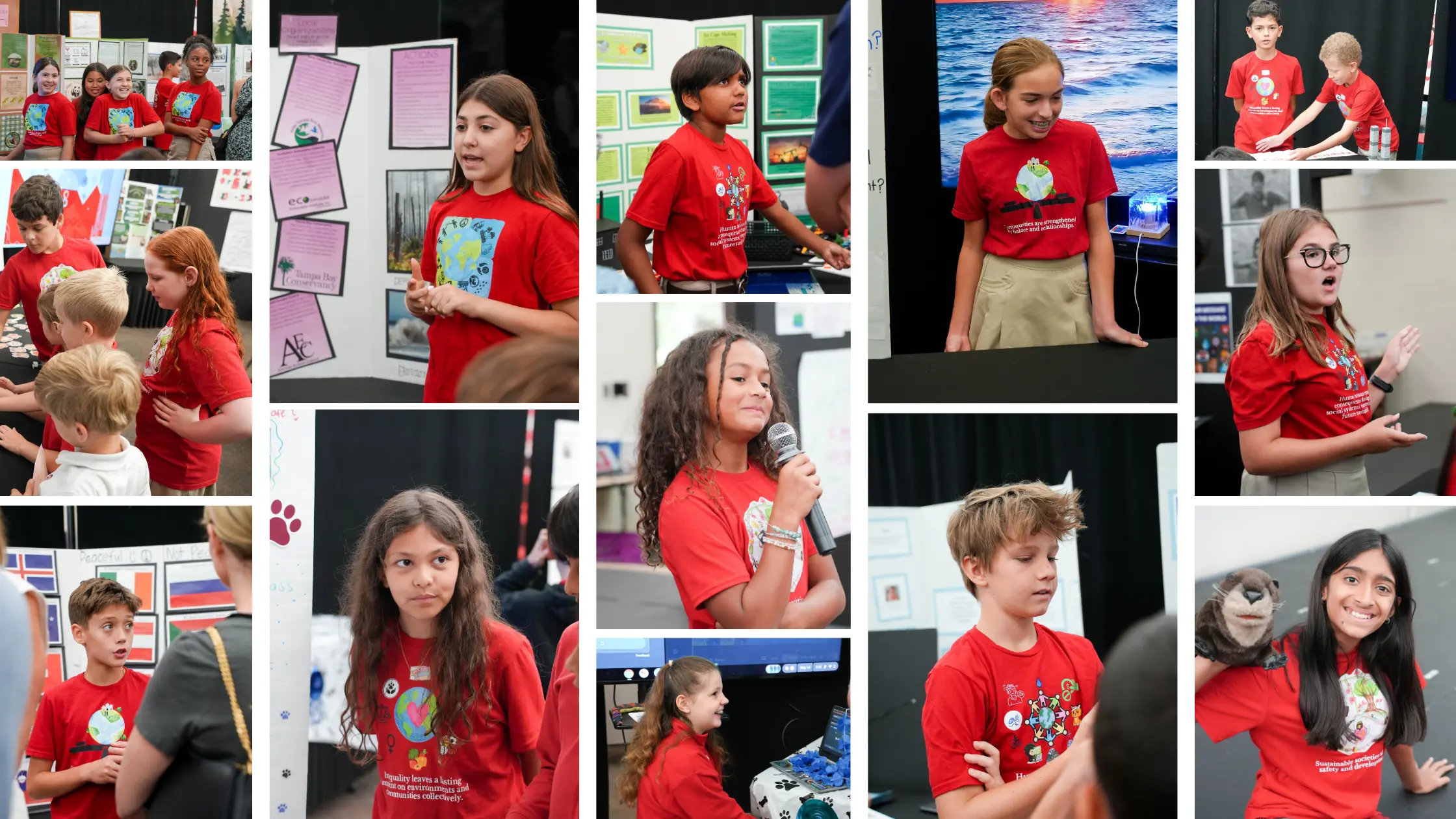
The work itself reflected the richness of this interdisciplinary approach. Students explored global warming by examining the causes and effects of climate change while inviting exhibition guests to consider their own environmental responsibilities through interactive simulations and pledges to protect the oceans. Others investigated animal welfare and conservation, encouraging younger students and families to think about how human decisions affect ecosystems, habitats, and animal well-being. Through hands-on activities, participants experienced the impact of deforestation, habitat destruction, and environmental imbalance in ways that transformed abstract concepts into tangible understanding.
Issues surrounding clean water, pollution, and sustainability challenged students to think like planners, problem solvers, and advocates. One group invited participants to design communities in ways that protected water sources from contamination, while others examined how human consumption contributes to pollution and waste. Interactive games, visual models, and collaborative challenges allowed students to guide others through the consequences of environmental decisions and the importance of responsible action.
Health and well-being also became important areas of inquiry. Students explored body systems, disease prevention, mental health, and community wellness through quizzes, journals, reflection prompts, and coping strategy activities. These projects encouraged participants to think critically about how communities support healthy living and how individuals can care for both their physical and emotional well-being.
Other groups turned their focus toward issues of inequality, poverty, and global peace. Through simulations, board games, matching activities, and storytelling experiences, students explored how unequal access to resources affects communities around the world. Participants encountered scenarios connected to food insecurity, education, housing, and collective responsibility, while students challenged them to think about fairness, empathy, and advocacy.
Artificial intelligence and internet safety also emerged as important areas of inquiry throughout the Exhibition. Students explored how AI is shaping the world around them while examining the responsibilities and risks that come with rapidly evolving technology. Through podcasts, quizzes, interactive games, and discussions with technology professionals, students encouraged participants to think critically about digital citizenship, online safety, ethical technology use, and the role AI may play in the future.
What stood out most throughout the Exhibition was the remarkable level of ownership students demonstrated. This year’s Exhibition evolved to more closely mirror the culminating projects students will later encounter in the IB Middle Years Programme and Diploma Programme. Each student had the freedom to shape their presentation in a way that reflected their personal vision, interests, and understanding. Whether through animations, games, models, literature, presentations, or immersive activities, students exercised complete agency over how they communicated their learning.
The Exhibition also revealed how deeply integrated learning becomes within the PYP framework. Students were not simply researching isolated topics. They were writing poetry in literature classes connected to their themes, designing multimedia experiences during technology instruction, teaching younger buddy classes about changemaking, conducting interviews, creating original resources, and developing opportunities for authentic community engagement. Every experience connected back to their central ideas and reinforced the understanding that learning extends far beyond the walls of a classroom.
On Exhibition Day, the CDS community gathered not simply to observe projects, but to witness students stepping confidently into leadership. Families, teachers, peers, and younger students interacted with displays that had been entirely imagined, researched, and created by the students themselves. Yet the lasting impact of the Exhibition reaches far beyond the presentations.
The true value lies in what students carry forward from the experience: the confidence to ask difficult questions, the ability to think critically about real-world issues, the courage to communicate ideas clearly, and the understanding that meaningful action often begins with small but intentional steps. As these students prepare to transition into the IB Middle Years Programme, they do so already equipped with the mindset of inquirers, collaborators, and changemakers.
The PYP Exhibition is not simply the end of elementary school. It is a milestone in a student’s journey as a learner and a reflection of what happens when curiosity, purpose, and agency come together. At Carrollwood Day School, our students are not waiting for the future to make a difference. They are already learning how to shape it.
Click HERE to view photos of all five Exhibition Days. Browse through the 5th Grade Exhibition brochure HERE to see all of the areas of inquiry.